Showing posts with label Sherlock Holmes. Show all posts

Monday, 10 June 2013

"As if men had the monopoly on murder": why Elementary is a feminist show

SPOILER WARNING: This post discusses the plot of Elementary episodes 22 (The Woman) and 23 (Heroine).

The fourth Great Sherlock Holmes Debate was this Saturday, and I was fortunate enough to participate yet again. Thanks so much to the organisers at MX Publishing for gathering together Holmesian experts from all around the world, it was fantastic to hear everyone's presentations and thoughts on various adaptations of our favourite detective.

The recording of the entire debate should be up online in a couple of weeks once everything is edited, so keep an eye out for that. There was a great presentation on the Warner Bros. Sherlock Holmes films by Mary Platt and an amazing contribution by Bonnie MacBird who told us all about BBC's Sherlock. Luke Kuhns talked about Holmes pastiches, and we also had the Holmesian legend Roger Johnson, author of The Sherlock Holmes Miscellany, deliver a presentation about Lenfilm's Sherlock Holmes adaptations starring Vasily Livanov and Vitaly Solomin as Russian Holmes and Watson. This is one of my personal favourites, so I was really glad to hear Roger talk about them. If you are so inclined, you can watch them all online here. The video quality isn't ideal, but it has English subtitles.

Natalie Dormer as Irene Adler in Elementary
My presentation was about Elementary, and although I only had about five minutes to try and explain why it was (or wasn't) a good contribution to the Holmesian legacy, I felt like it went pretty well and the feedback I received was all positive. In it I talked a little bit about how the show's announcement was met with astounding negativity and how it withstood all the criticism that was thrown at it and came out to be one of the most watched shows on CBS. I briefly touched upon the show's female characters and how I thought they were handled very well – I said that, in my opinion, Lucy Liu's portrayal of Watson was perhaps the closest to the original, Doyle's Watson, and I mentioned that Elementary's writers were mindful of having both their male and female characters multi-dimensional and complex, without resorting to tropes or the unfortunately popular virgin/whore dichotomy. I'd like to expand on this, primarily by talking about the most important woman in Sherlock's life: Irene Adler.

I have discussed the treatment of Irene Adler in a previous post, where I talked about her updated character as it was shown to us in the episode A Scandal in Belgravia in BBC's Sherlock. In this, her characterisation went from a point of strength to utter weakness, as the narrative displaced her from her strong, empowered queer identity and depowered her to suit itself and the character progression of its (presumably heterosexual) male characters. In essence, she had at least one foot in the refrigerator. (Here is a very good summation of the women in refrigerators trope.)

In Elementary, however, Irene Adler starts out in the deep, cold depths of the fridge, and then fights her way out. At first she is merely a mention, the beautiful dead girlfriend type who probably starred in most of Edgar Allan Poe's dreams and fantasies, the ethereal artist whose demise at the hands of the second most dangerous man in London drove the world's greatest detective to lose all semblance of control over his drug use. By now mostly everyone is familiar with the quote – to him, she was the Woman, the late Irene Adler. But is she? Adler is indeed, as Elementary shows us, one of dubious and questionable memory. She is not late at all: in fact, it turns out that she is Moriarty, Holmes's arch nemesis and the cause of most of his misfortune to date. The Woman and the Napoleon of Crime are thereby fused into one person. Which one of them beat Holmes, then? Canon tells us that they both did, at least for a time, and the same thing happens on Elementary. It's not done with the same drama that we saw in The Reichenbach Fall or read in The Final Problem, but then again the finale of the first season of Elementary wasn't meant as his plunge down a waterfall, simply a bump in the road, albeit a very significant one for Holmes.
Candis Cayne and Jonny Lee Miller
as Ms Hudson and Sherlock Holmes in Elementary

Adler's transformation teaches Holmes that there is no such thing as the Woman, because there is no such thing as a perfect representative of the female gender. There is no girl in the fridge, there isn't a virgin or whore because they are all people, and this is Elementary's greatest strength: people. Moriarty's characterisation isn't perfect and lacks some depth that other characters have, but this is to be expected since we have only seen her in one episode, while all the other characters got at least 23. Here's to hoping this won't be the end of Moriarty and she'll return in the second season.

Of course this isn't the only reason why I think that Elementary is a feminist show: there is Ms Hudson, a transgender character played by a transgender actress (Candis Cayne), who is treated with respect and not subjected to sexual violence, which is a rare occurrence when it comes to portrayals of transgender characters in mainstream media. However, perhaps the best example to support my argument here would be Joan Watson.

Lucy Liu as Joan Watson in Elementary
Some critics expressed certain misgivings about the fact that an actress was cast in the role of Watson rather than going for the traditional choice of a male lead, but I have already talked about this in a previous post. Suffice to say, none of their worries came true. Elementary did not take Holmes and Watson's friendship for granted, it built it from the ground up. Their relationship is one based on trust and respect, and the show goes to great lengths to make sure the audience sees how that trust and respect is gained. Joan was shown as an equal to Sherlock rather than just his sounding board: she listens to him and learns from him, but he also learns from her.

One of my main complaints about Sherlock is the fact that Watson is not someone who is independent to Holmes: he is second fiddle, an accessory, someone intelligent enough for Holmes to bounce his ideas off, only this and nothing more. He sometimes makes a heroic effort of biting back, but there is never the sense of an equal footing. He is always running to catch up. Joan Watson starts out as an employee with her own hopes, ambitions and demons, and she turns from an employee into a partner and a friend, a detective and a heroine. She is shown to be intelligent, hard-working, caring and entirely independent: she bludgeons criminals and breaks into cars, and she solves cases on her own. She helps Sherlock be a better person, as he himself tells her. Watson is not afraid to call anyone out on their nonsense, least of all Sherlock. When he suggest that she is in a bad mood because she's on her period and saying that he's worked out her schedule, she comments: "Couching it as a scientific observation totally negates the misogyny."

There's a reason the second part of the Elementary finale is called Heroine. It's not just Sherlock, it is also Watson who wins in the end, and her victory is not just over Moriarty, but also over misogyny. In a scene, Moriarty and Watson meet in a crowed restaurant, and Moriarty says this: "As far as I can determine, you're a sort of... mascot. You were his sober companion, a professional angel to perch on his shoulder, fend off his many demons, but now... now I don't know what you are. Do you want to sleep with him?" To this, Watson replies with: "I thought you told him that you were just like him. That you saw the same things that he did." Moriarty succumbs to internalised misogyny and she underestimates Joan Watson just as some of the previously mentioned critics of the show underestimated Joan Watson, and Moriarty fails because of that.

Elementary punishes misogynists and rewards those who fight misogyny, and in this current media climate of racism and sexism, where characters are whitewashed (spoilers for Star Trek: Into Darkness at the link) and female characters perpetually get naked for the enjoyment of the audience and nothing more, seeing someone like Joan Watson and Ms Hudson is a refreshing and welcome change, and I for one eagerly await the second season of Elementary. 

Thursday, 17 May 2012

Changing Sherlock: CBS go 'Elementary'

There has been heated discussion about the decision of the American commercial television network CBS to pick up Elementary, a show that is very much reminiscent of BBC's Sherlock: we have Holmes and Watson, and they are in the twenty-first century. Steven Moffat has been heard to complain about CBS's decision to produce a show so similar to Sherlock. Originally, the Sherlock production team was approached by CBS with a request to remake Sherlock for the American market, but they were turned down. According to Steven Moffat, despite being rejected, CBS 'decided to make [a show about Holmes in the twenty-first century] anyway'. While it is understandable that the writer of a show about Holmes in the twenty-first century would feel a certain amount of indignation and protectiveness over their idea getting picked up by a different network, the fact remains that the base for the script of Elementary was written in 2000, and that Sherlock owes its popularity not only to its good writing, but the fact that it rode in on the coattails of Guy Ritchie's Sherlock Holmes film, showing impeccable timing.


After various promo pictures of Watson and Holmes floating around the internet, last night CBS released a preview video for Elementary, starring Lucy Liu as Joan Watson and Jonny Lee Miller as Sherlock Holmes. In an interview with The Insider, Steven Moffat was quoted to say: "[Mark Gatiss and I] welcome it, but don't damage the brand."

Speaking of the Holmes brand being damaged, it should be taken into account that Holmes fought against Dracula, the forces of Cthulhu, robotic dinosaurs created by his fictional older brother, went against another fictional older brother alongside the Doctor, and that he was also a dog and a mouse. None of these adaptations have damaged the brand, and it is presumptuous to assume that future pastiches will: with adaptations, there is no should or ought to, and the fact that the writers can play around with the original characters is exactly what makes adapting (and fan fiction) so appealing.

In the same interview, Moffat also added: "[Elementary have] got three big changes: it's Sherlock Holmes in America, it's Sherlock Holmes updated and it's Sherlock Holmes with a female Watson. I wonder if he's Sherlock Holmes in any sense other than he's called Sherlock Holmes", which echoes the concerns of many fans of BBC's Sherlock.

First of all, concerning setting the series in America: although it is true that London is basically a character in its own right in the canonical stories, during Victorian times Britain was the biggest empire of the world, and London was just as, if not even more, culturally and racially diverse than it is now. Sherlock Holmes is far from being exclusively the domain of the middle-class heteronormative white male. Holmes and Watson have dealt with Americans, Indians, the Chinese, Italians, Australians, and countless other ethnicities which I am probably forgetting. If you want a culture clash, you need not look further than nineteenth century Britain. Some of the stories which have Holmes deal with a foreign presence are: The Sign of Four, Valley of Fear, The Yellow Face, The Five Orange Pips, The Greek Interpreter, The Illustrious Client, and others. Displacing Holmes in America would in no way diminish the quality or the authenticity of the characters, or make him less of a Holmes.

Elementary promo picture
As to putting Holmes in the twenty-first century, he has already been introduced to the twenty-second century. Everyone was sceptical about Sherlock originally, and the decision of the creators to place the detective in modern day London, and yet it proved to be a brilliant move, winning the show several prestigious TV awards.

Complaining about Watson being turned into a woman of colour, as many fans of Sherlock have done, is another issue. Conan Doyle wrote Holmes and Watson as men because it was the natural thing: women didn't serve as officers in the army, and they were not doctors in Victorian times. It would be very difficult for a woman to have independent means enough to be a consulting detective and to live on her own, unless she was a widow or she was protected (both financially and in other ways) by an older, male relative like a father, grandfather or uncle. Doyle was twenty-seven when he wrote the first Holmes story, and he wasn't progressive in his writing and perception of women until later in life. Also, platonic male friendship of the kind that Holmes and Watson had was held in high esteem in Victorian society: men loved to read about it, and it gave them something to aspire to in their own relationships.

Those are all the social implications of gender and the perception of masculinity in Victorian society. However, if we strip the friendship between Holmes and Watson down to its bare bones, there is nothing gender-dependant about their friendship that immediately jumps out. They respected and loved each other because of their intellect, bravery, and quick-wittedness. These traits are not bound exclusively to the male gender, or a male friendship. Writing a female Watson is a double edged sword, and personally I have to say that I am worried: not because it is a female Watson, but rather because how she, and her relationship with Holmes, will be portrayed.

Finally, the only thing left to say about Elementary is that it should be given a chance. It is a very risky venture and it has equal chances to success or fail, but we won't know whether it's done the former or the latter until the first episode airs on CBS this autumn.

Monday, 2 January 2012

Sherlock and The Woman: What on Earth Happened to Irene Adler?

SPOILER WARNING: This post discusses the plot of Sherlock: A Scandal in Belgravia.

I enjoy Sherlock as a show. It has many faults, but I have respect for what it is doing and how it is trying to modernise Conan Doyle's stories. Some of the modern translations of Victorian plot points, tropes and 'gadgets' have worked extremely well and have been done with the writers paying great respect to the canon they were using. My compliments in this respect especially go out to Mark Gatiss for the episode The Great Game in the first series and the way that the writers have so far treated the character of Moriarty.

However, no television show is flawless, or tries to be. Sherlock, for one, has always had problems with how it portrayed female characters, and these problems have only been accentuated with the first episode of the second series, A Scandal in Belgravia, aired last night.

Irene Adler in Sherlock Holmes, played by Rachel McAdams (source)
Holmes's treatment of and attitude to women is that of a rescuer, which perpetuates the idea that women require to be rescued by men, that women are passive when in peril, and the only way they can be removed from a threatening situation is by male interference. Men, the narrative of Sherlock shows us, are at their most manly when they are fighting side by side to rescue women. Sarah Sawyer, from The Blind Banker, is an independent person – she is a doctor and a working woman who knows what she wants, and she is independent. She fights off Chinese smuggler acrobats like it's her job, until the very end of the episode, when she is captured and tied, and almost shot through with a spear. All her previous strength and independence is obliterated in order to serve the purpose of furthering the narrative, and, more importantly, to show her being rescued by a more successful and more able male protagonist – in this case, Holmes. All merit as strong female characters that she has had up to this point is lost, as she serves to further assert that masculinity is more powerful than and superior to femininity.

The myriad of women from various occupations and walks of life makes Sherlock a very modern work when it comes to the treatment of femininity. At the same time, however, it is steeped in nineteenth-century misogyny and sexism in the way these women are treated, both in the construction of the narrative and by the characters within it. Unlike the men, who are all (mostly) well-rounded and complex, the women in Sherlock serve as one-dimensional character types. In fact, the female characters are a typical example of the Victorian idea of binary coding of female identity, the Whore and the Virgin, if you will.

Female characters are seen through and defined by a male perspective, and not in their own right. In the first series, Sally Donovan is a sergeant of Scotland Yard, a position which she would have attained through extremely hard work, being both a woman and a person of colour, the only example of both of these traits in the all-male, all-white team. However, she is shown only through her negative history with Holmes, which has turned her bitter and reduced her dialogue to almost exclusively calling him 'freak'. Moreover, she is shown through her subordinate relationship with men, be it personal or private: she is both 'guilty' of office romance, the alleged partner in an alleged affair, for which Holmes openly shames her in front of her colleagues. Molly Hooper is a pathologist at St Bart's Hospital – a position which would have taken her at least five years to qualify for – and yet she is characterised solely as being love struck and wide-eyed towards Holmes, even though he treats her with no respect.

The relationship that the Holmes we see in Sherlock has with its women is very much different to the kind of Holmes that Watson describes in The Adventure of the Dying Detective:  'He had a remarkable gentleness and courtesy in his dealings with women. He disliked and distrusted the sex, but he was always a chivalrous opponent.' In Sherlock, Holmes exploits women for being female, and he is far from courteous or gentle with them. He plays on the stereotypically 'female weaknesses' – emotions, vanity, and sexuality – in order to manipulate them into giving him what he wants. Women, as they are written in Sherlock, mainly through the pen of Steven Moffat, are body and nature, determined by and a slave to their emotions, hormones and instincts. Men, on the other hand, transcend their biological materiality and 'basic instincts' such as emotion or sexual desire: women are entrenched in their physicality. They can try to be like men, in the sense that they can try to conquer their emotions, but Steven Moffat teaches us, on the example of Irene Adler in A Scandal in Belgravia, that they can never succeed.

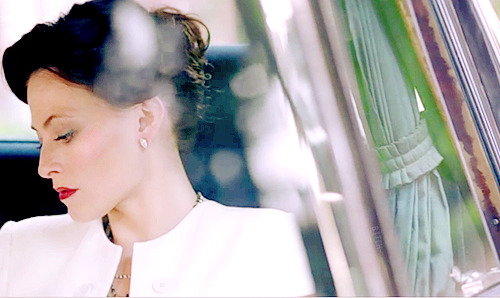
Irene Adler in A Scandal in Belgravia, played by Lara Pulver (source)
In adapting A Scandal in Bohemia or just involving Adler in other stories, most writers seem to forget (whether by accident or by design) that 'the woman' was the only person in the canon to ever outsmart Holmes and leave him on her own terms. They also seem to forget that Adler had no romantic interest in Holmes – in fact, she was trying to marry Godfrey Norton, who is rarely even alluded to, or more often completely omitted from adaptations. The most recent unjust treatment that Adler received was in the 2009 Sherlock Holmes by Guy Ritchie, and you can read about that in more detail in Renee Cohn's excellent blog post, A Defense of Irene Adler, in two parts.

I had hopes for this modernised Irene Adler, and despite Moffat's notorious history of failed female characters, most recently seen in the Doctor Who Christmas special, I went into the episode with an open mind. The modern Adler is a sex worker and a dominatrix, a profession which is treated with an unexpected and welcome lack of prejudice by both the writer and the characters. She uses her intellect and her sensuality in an equal degree to achieve her goals: again, a welcome change to female characters (and previous Irene Adlers) who are shown as using sexuality as their only weapon. She is clever, capable, resourceful, and follows faithfully the Adler that Conan Doyle envisioned in A Scandal in Bohemia in 1891, a time when New Women started redefining the meaning of femininity, and the strict rules that had up to then governed gender and sexual identity were starting to break down. Although femininity and masculinity are safe within their traditional frames in most of Conan Doyle's stories, Adler is one character that challenges them, and in the end outwits the super sleuth.

This refreshingly well-done portrayal of Adler is pulled off in A Scandal in Belgravia in the first 90% of the episode. Adler plays a game of cat-and-mouse with Holmes and she is seen as always having the upper hand: at one point, she drugs Holmes and escapes, leaving him passed out on the floor. When she first meets Holmes, she is completely naked, not because she wants to present herself as an object to be lusted after, but because she knows that Holmes reads people based on their clothing, and that way she remains an enigma to him. Her clients are both male and female - the primary plot of the show is that she has some compromising photographs of herself with a female member of the Royal Family - and she identifies herself as gay in an exchange with Watson. A positive portrayal of a queer sex worker on prime-time television? It's almost too good to be true, since queer women in mainstream media are almost always erased or fetishised.

Unfortunately, Adler's self-identifying as gay is completely forgotten when Holmes enters her life. 'Brainy is the new sexy', she declares, and Holmes is able to beat her based on the fact that he deduces she is 'in love' with him because her heart rate increased when their hands touched and her pupils dilated when they were close. The issue here is not so much that lust and love are confused in a blatant display of ignoring basic biology, but rather that a presumably lesbian character has fallen in love with a man. Of course, I am not denying the fact that sexuality works very differently for each person and that it is fluid and subject to change: the problem with Adler falling head over heels for Holmes is the fact that she, as a queer woman, falls prey to erasure like so many before her. Up to this point, her sexuality was not the primary defining point of her character.

It goes further downhill from there: the viewer finds out that Adler's intellect and resourcefulness are not her own. She was helped by Jim Moriarty all along, and the narrative once again becomes the traditional Moffat story of women not being able to succeed independently. The point is rammed home at the end of the episode - a weeping, bound Adler (reminiscent of the one in Sherlock Holmes) is saved from death by the heroic Holmes.

The message is clear: women cannot fight their own battles. They will always need a man to save them in the end, either from an outward threat, or from their own misguided sexuality. Adler in A Scandal in Belgravia had a lot of potential to be the best Irene Adler since 1891. She was independent, her sexuality was not her sole defining feature or primary weapon, and she outsmarted Holmes. And then, with a penstroke and a camera tilt, she was lying in Holmes's bed, a crying mess, she had let her emotions play her for a fool (the password to her phone was made to read 'I am Sherlocked', which, all previous things considered, could not be meant in an ironic manner), she was the pawn of Moriarty, and she had to be rescued by a strong, brainy masculine presence.

This starts out as a kind of Irene Adler that Conan Doyle wrote, and ends a twisted caricature of the fantastic, clever person from A Scandal in Bohemia. Has Steven Moffat finally succumbed to a bad case of George Lucas syndrome? And can female characters, queer or otherwise, hope for a good portrayal on the BBC if one of their most prominent writers has them put in the place he wants them, subordinate to men?

Wednesday, 21 December 2011

'Sherlock Holmes: A Game of Shadows' reviewed

SPOILER WARNING: This post discusses the plot of Sherlock Holmes: A Game of Shadows.

I was wary of what kind of film Sherlock Holmes: A Game of Shadows was going to be. I have been a fan of Guy Ritchie's work since Lock, Stock, and Two Smoking Barrels, and he had proven that he could make a compelling Holmes film with the first Sherlock Holmes. However, sequels often prove to be terrible ideas with an even worse realisation.

I have heard many argue that Ritchie's Holmes isn't 'the real' Holmes, for various reasons: too much fighting, too few truly genius deductions, too little time sitting around in comfy chairs in 221B expositing on the plot, that Downey was too American and that, in a nutshell, the first film was focusing on all the wrong things to make it a 'real' Holmes film – although enjoyable, it would not have the same standing in the eyes of traditional Holmes fans as a Brett or a Rathbone. What's often forgotten when this kind of argument is presented is the fact that Sherlock Holmes adaptations have been ever-changing and not entirely faithful to the canon since their inception, and it is perhaps this discrepancy with the canonical stories that allows the new Holmes adaptations to play around with and explore the original stories more.

Just like the first Sherlock Holmes done by Ritchie, A Game of Shadows is not based on any of Conan Doyle's canonical stories, but it has many references to them. The main villain this time is Professor James Moriarty, the most famous criminal to all admirers of Holmes. The film does Moriarty justice and his character is expanded further from what he is presented to be in The Final Problem and The Valley of Fear: with a striking scene in which the power of Moriarty's influence empties one of Victorian London's most busy and famous restaurants, the audience is shown the staggering amount of power that Moriarty holds over London.

Jared Harris as Moriarty is perhaps one of the best portrayals of the professor to date: he isn't afraid to step away from the hunched, wizened professor of Paget's illustrations and Conan Doyle's descriptions. His Moriarty is both reserved and theatrical, controlled and chaotic, charming and terrifying, depending on which role he plays: that of the professor or of the master criminal. It's all about the subtleties: when displeased, he doesn't lash out, but it is clear how irate he is when his pencil slips on the paper and his wrist jerks violently. Harris' Moriarty isn't susceptible to cackling or moustache-twirling like a one-dimensional storybook villain: a simple smile at the right moment accomplishes more than the loudest laugh, and makes the viewer more afraid, and also perhaps awed, of his character. Moriarty's duality of a genius university professor and a criminal mastermind is well incorporated into the narrative, both visually and though the way he speaks, when he uses astronomy metaphors and exploits his European lecture tour as a front for consorting with anarchists and planting bombs in ambassadors' chambers. With his ambitions in the film for bringing about a world war and then supplying both the sides with weapons, this Moriarty is an interesting balance of chaos and control, and the two sides are always fighting for dominance, one never quite triumphing over the other.

Something which A Game of Shadows has improved on since the first film is its female characters – in Sherlock Holmes, Irene Adler is defeated and subdued by Holmes, left sobbing and handcuffed on top of Tower Bridge as her unrequited love interest swans away triumphantly. In A Game of Shadows, Mary Morstan takes complete control of the situation when she and Watson are attacked on their honeymoon – she wields a gun with confidence and dispatches with the threat without a moment's hesitation. Madam Simza Heron, played by Noomi Rapace, is more than capable of defending her own corner with limited help from the male protagonists – she is shown with a weapon from the start, and she uses it with skill and poise. Unlike Adler in the first film, Madam Simza is never in the position of a helpless damsel in distress who is unable to fight her own battles; and, refreshingly, she shows no romantic interest in either Holmes or Watson. When placed in a mostly-male environment of a Gypsy camp, she is still independent and even waited on by the men.

Although it doesn't offer passionate sloppy make-outs (rooftop and/or rain optional) between the leading man and lady which serve to satisfy the desires of those projecting themselves into the leading man's character but are otherwise completely unrelated and unnecessary to the plot (looking at you, Iron Man 2, Thor, et cetera, ad nauseam), the film does have a coherent romantic, and most of all, realistic heterosexual plot. Firstly it's the marriage of Watson and Mary Morstan, which is portrayed with deserved respect and realism, and secondly it's Holmes's devotion to Irene Adler, which is romantic and platonic more than sexual. They are seen kissing, but only when it's used as a distraction to pilfer something from each other's person, rather than a sign of affection. Of course, the female characters in A Game of Shadows still leave much to be desired – Adler's primary weapon is still her sensuality rather than her intellect, and both she and Morstan are done away with so as to make way for Holmes and Watson's shenanigans, but the portrayal of women has still improved since Sherlock Holmes.

A further thing that A Game of Shadows does right is place the plot in a coherent and even mostly accurate historical setting – the film is set in 1891, and it is immensely pleasing to me as a Victorianist to see the start of construction of the underground railway in Baker Street. This makes sense because the London Underground was opened in 1893, so it was a nice touch from the producers to add that in. There is also the way the plot leans on the evolution of weaponry and the use of dynamite and explosives, which at the same time shows Victorian progress and the fear of what this progress might cause, and is furthermore, perhaps, a nod towards the Fenian dynamite campaigns between 1881 and 1885. There is some creative freedom employed when the plot deals with facial reconstructive surgery (this kind of surgery wasn't perfected or even performed until well into the second half of the twentieth century): however, it ties in well with the overall theme of the film of disguise and deceit, and the Victorian obsession with changing one's face to look like someone else. The huge size and power of the British Empire is felt more keenly in the way that the film shows characters such as Chinese opium smokers, Cossacks, military maps and the character of Mycroft Holmes working for 'Her Majesty's Secret Service' (which was unfortunately not officially founded until 1903, but Mycroft is more likely a homage to William Melville) and meeting other diplomats in high-profile events which decide the future of Europe.

Holmes and Watson are still the two characters who carry the film, as they should be, and Downey and Law do a very good job. There is a satisfying balance of banter, arguments, respect, and co-dependency to make their relationship believable and enjoyable, and it is no longer felt, like in Sherlock Holmes, that Holmes is the more clingy, desperate one: the affection is obvious on both sides, although expressed in different ways. There are some scenes which appear gratuitous and done as fanservice – the brief tussle on the train and the dance in Switzerland. On the other hand, there are several moments when their affection for each other is subtly, yet magnificently portrayed with just one simple look or gesture.

My personal favourite thing about A Game of Shadows was the inclusion of Colonel Sebastian Moran. Many directors either forget about or consciously axe Moran from the plot when including Moriarty, even though Holmes describes Moran as the 'bosom friend' of Moriarty in The Empty House. In A Game of Shadows, Moran is included alongside Moriarty from the start, and even though he is described by Holmes as someone akin to a gun for hire, it is shown on more than one occasion that Moran's interest in Moriarty isn't simply protecting a colleague and business investment, but that there is also an emotional connection, and perhaps a friendship, between the two men.

Although it has its faults and questionable moments, A Game of Shadows is more than a worthy sequel to Sherlock Holmes. It doesn't try to be something it's not, and it offers a satisfying balance of action, deduction, villainy, canonical references, and banter. Both the mannequin in the window of the 221B sitting room and the ending of the film promise a sequel. I, for one, welcome it.

Saturday, 5 November 2011

The Great Sherlock Holmes Debate

On November 10 at 8 pm GMT, MX Publishing are organising The Great Sherlock Holmes Debate, in which three teams will be pitted against each other in an online debate, where it will be discussed which of the many types of Sherlockian adaptations has contributed the most to upholding the legacy and continuing the popularity of the great detective well into the twenty-first century.

There will be three teams, representing BBC's Sherlock, Warner Bros.' Sherlock Holmes films done by Guy Ritchie, and the 'traditionalist' team. Some of the participants in the debate include The Baker Street Babes, Sherlockology, Nick Briggs, Roger Llewellwyn, and Alistair Duncan. You can check out the full lists of team participants here.

I am very happy and incredibly honoured to be involved as a part of the Traditionalist team, captained by Nick Briggs. Here is an introductory slideshow of the team members. I hope I will be able to offer adequate contribution to the debate and make the experience interesting, fun and thought-provoking for all involved, and I hope my knowledge (my MA dissertation, Sherlock Holmes and the Celluloid Wonder: Re-Imagining the Detective in the Twenty-First Century, dealt with this topic) will make up for my anonymity.

Remember to 'like' The Great Sherlock Holmes Debate on Facebook! The Debate is supporting two very important causes: Save Undershaw, for the preservation of Conan Doyle's home, and BAFTA for Jeremy Brett.